


Data Analysis and consulting insights from actionable data, that amplifies growth.
If you can’t find data that propels strategy from digital marketing data analysis then you’re missing the entire leveraging asset digital marketing provides. Actionable data is paramount – it is where you go from good to great. It is how you turn real user data from your website, socials, CRMS and more, into an employee that drives tangible, bottom-line results.
Your Growth Starts Here
Remove the guesswork, leverage actionable data – then monetize it
TL;DR: The Quick Summary
How data analysis and consulting create growth
Why data analysis works
TL;DR: The Quick Summary
How data analysis and consulting create growth
Why data analysis works
The importance of Data Analysis
What is implemented, must be measured.
Data analysis is pivotal. Without analyzing the data sets associated with your digital marketing efforts, you cannot optimize those efforts. If you don’t optimize those efforts – you absolutely leave money on the table. Whether you’re endeavoring in SEO, PPC, Social Media Ads, or any other digital marketing medium, finding your sweet spots on investment, copy, targeting, and more all come from data analysis.
The best data analysis efforts are usually tied to consulting retainers and ongoing digital marketing efforts. Without digging into user behavior, taking user polls, and listening to any channels user engagement insights you lose out on the golden key of all digital marketing – actionable data.

Inside The Strategy How It Works
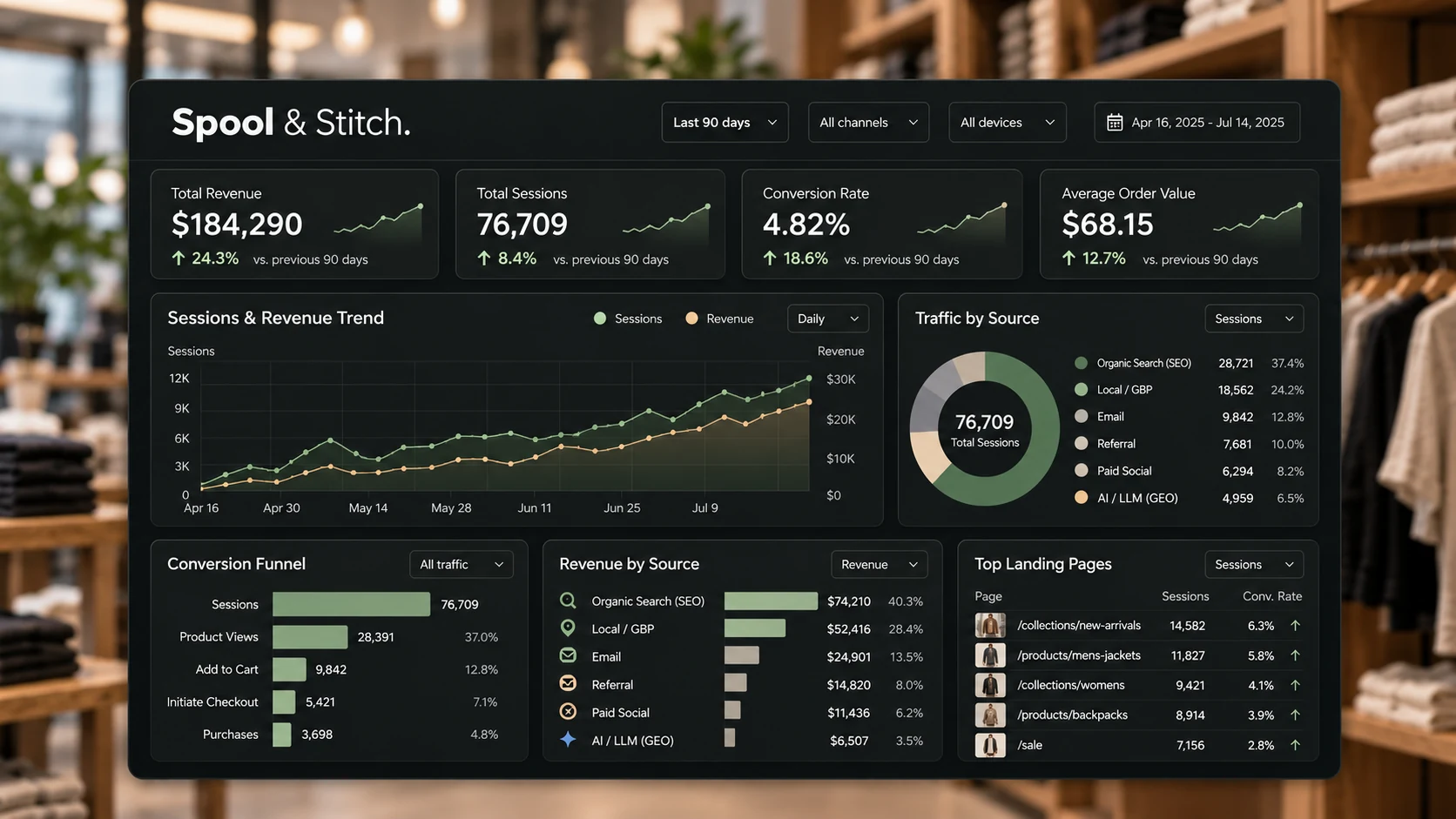
Data analysis takes the information your business already produces and makes it useful. Traffic, leads, conversions, customer behavior, acquisition costs, revenue, campaign performance—there is no shortage of data available. The challenge is knowing what matters, what doesn’t, and what the numbers are actually telling you.
Digital marketing data analysis brings that information together. Website analytics, paid media, SEO, social, email, CRM data, ecommerce performance and other digital touchpoints all contribute pieces of the story. Analyzing those pieces collectively provides a much clearer understanding of what is driving performance and where opportunities—or problems—exist.
This is where data analysis separates itself from reporting. Reports tell you what happened. Analysis digs into why. Why did conversions increase while traffic declined? Which channels are actually producing profitable customers? Where are users dropping out? What changed, and what should change next?
The point isn’t more data. Most businesses already have plenty of it. The point is extracting the right information and using it to make smarter decisions, strengthen strategy and drive measurable growth.
Good data analysis starts with good data. Tracking has to be accurate, platforms need to be configured correctly, and KPIs need to align with actual business objectives. Otherwise, you’re simply analyzing bad information more efficiently.
From there, digital marketing data analysis connects performance across channels, campaigns, audiences and customer journeys. Individual metrics matter, but rarely tell the whole story on their own.
More traffic isn’t necessarily better traffic. Lower acquisition costs aren’t a win if customer quality falls. Revenue growth looks great until you realize the cost required to generate it grew even faster. Context matters.
That is the work. Analyze the relationships between the numbers, establish meaningful benchmarks, identify trends and determine what is actually influencing the outcome. As reliable historical data builds, those insights become stronger. You stop reacting to isolated metrics and start making decisions with a much clearer understanding of how the business and its marketing are performing.
If you’re investing in digital marketing without properly analyzing the results, you’re making decisions with only part of the picture.
Businesses spend across SEO, paid search, paid social, email, content, CRO and countless other digital initiatives. Knowing what was spent and what each platform reports back is not enough. Digital marketing data analysis determines where those investments are creating value, where they’re wasting it, and where the next opportunity may be sitting.
It also exposes how customers actually interact with your business. Where did they find you? What brought them back? Which touchpoints influenced the conversion? Where are prospective customers leaving the funnel? Which channels contribute to revenue even when they don’t receive final attribution?
Data should inform the strategy, not become the strategy. Experience, judgment and business acumen still matter. Data analysis gives those decisions substance. It helps remove guesswork, challenge assumptions and give business owners and executives a clearer basis for deciding what deserves more investment—and what doesn’t.
If your business invests meaningful dollars into digital marketing, data analysis should be part of how those investments are managed.
It becomes increasingly important as complexity grows. Multiple marketing channels, locations, products, services, audiences and customer touchpoints create more data, but they also make performance harder to evaluate at face value. Digital marketing data analysis connects those moving parts and provides a more complete view of what’s actually happening.
For ecommerce brands, B2B companies, professional services, multi-location organizations and businesses managing substantial marketing budgets, that visibility can directly influence where money and resources are allocated.
Data analysis is just as valuable when performance is strong as when it isn’t. Growth creates opportunities to find what’s working and exploit it further. Underperformance demands answers. In either case, better information creates a stronger position from which to make the next decision.
The real benefit of data analysis is clarity.
It helps businesses understand customer behavior, uncover inefficiencies, evaluate marketing channels, improve attribution, identify opportunities, optimize spending and make better-informed decisions about where growth can come from next.
Digital marketing data analysis also creates accountability. Vanity metrics are easy to report. Impressions, clicks, traffic and engagement can all look impressive in isolation. What matters is whether marketing is contributing to qualified leads, customers, revenue, profitability and the broader objectives of the business.
The longer accurate data is collected and analyzed, the more useful it becomes. Historical benchmarks develop. Patterns emerge. Anomalies become easier to recognize. Forecasting improves. Decisions have more context behind them.
You don’t need more dashboards telling you what happened last month. You need to understand why it happened, what it means for the business and what you’re going to do with that information.
That is the value of properly executed data analysis.
Why It Matters
Why Leveraging Data Analysis Is Pivotal For Success
Sustainable marketing success is not built on assumptions. It comes from continually analyzing, learning and optimizing around what the data proves. When every marketing dollar matters, actionable data provides the clarity to invest smarter, eliminate waste and scale what works. Digital marketing data analysis turns raw performance data into those actionable insights, connecting channel performance, customer behavior, attribution, conversions and marketing ROI. Effective data analysis identifies what’s working, what isn’t, and where the greatest opportunities exist to make smarter decisions and drive sustainable growth.
5X
more likely to make decisions faster than competitors.
15-30%
of marketing spend can be freed up by proper analysis.
85%
higher sales growth for businesses leveraging customer insights.
2.6X
more likely to outperform competitors in ROI.
What’s the framework to successful Data Analysis?
Unleveraged data produces zero value.
Data Infrastructure & Tracking
- GA4 / GTM implementation
- Event & conversion tracking
- Data layer validation
- Tracking integrity & QA
Measurement & Attribution
- Channel attribution
- Conversion-path analysis
- Revenue / lead attribution
- Assisted conversion analysis
Channel Performance Analysis
- SEO performance
- Paid media efficiency
- Social / email performance
- Cross-channel comparison
Audience & Behavioral Insights
- User segmentation
- Device & geographic behavior
- Engagement patterns
- Customer journey analysis
Funnel & Conversion Analysis
- Funnel progression
- Drop-off identification
- Conversion-rate analysis
- Path-to-purchase insights
Testing & Experimentation
- A/B testing analysis
- Test hypothesis development
- Statistical significance
- Performance validation
Financial & Efficiency Analysis
- Cost per acquisition
- Return on ad spend
- Customer acquisition economics
- Budget efficiency
Reporting & Actionable Insights
- KPI dashboards
- Trend identification
- Anomaly detection
- Strategic recommendations
FAQs about Data Analysis
What Does Data Analysis Actually Tell You?
Digital marketing data analysis tells you what is actually happening across your marketing—and, more importantly, why. It connects performance across channels, campaigns, audiences, conversions and customer behavior to identify what is driving results, where opportunities exist, and where performance is being lost.
Reporting can tell you traffic increased 20%. Data analysis determines where that traffic came from, whether it converted, what it cost to acquire, how valuable those customers became, and whether the increase actually benefited the business. The objective is not more numbers. It is actionable insight that gives you a clearer understanding of performance and what to do next.
How Can Data Analysis Improve Marketing ROI?
Data analysis improves marketing ROI by identifying where your marketing dollars are producing value—and where they are not. It allows businesses to compare channel performance, acquisition costs, conversion rates, customer behavior and revenue to make better decisions about where budget should be invested.
The real value comes from what happens next. Underperforming campaigns can be corrected or eliminated. Strong channels can receive greater investment. Conversion opportunities can be uncovered, audiences refined and budget reallocated based on performance rather than assumptions. Effective digital marketing data analysis creates a continual cycle of measuring, learning and optimizing to get more from the dollars already being spent.
How To Know Which Marketing Channels Are Actually Working?
Knowing which marketing channels are working requires looking beyond the metrics each individual platform reports. Google Ads, Meta, GA4, your CRM, email platforms and other systems measure performance differently, and each provides only part of the customer journey.
Data analysis connects those touchpoints and evaluates them against meaningful business outcomes: qualified leads, customers, acquisition costs, revenue and ROI. A channel does not need to receive final attribution to influence a conversion, just as a channel generating large amounts of traffic is not necessarily creating meaningful business value. Proper analysis provides the context needed to understand which channels are contributing, how they work together, and where your marketing dollars are best spent.
Do I Need Data Analysis If I Already Use GA4 And Marketing Dashboards?
Yes. GA4 and marketing dashboards provide the data; they do not replace the analysis.
Dashboards are excellent for organizing information and monitoring KPIs, but seeing what happened is different from understanding why it happened. Digital marketing data analysis examines relationships between channels, campaigns, customer behavior, attribution and business outcomes to determine what the numbers actually mean.
The platforms are tools. The value comes from knowing what to look for, questioning what the data appears to say, finding the relationships that matter and turning those findings into strategic direction. Without that layer of analysis, even sophisticated reporting can become little more than a collection of numbers.
How Much Do Data Analysis Services Cost?
This boils down to project size, scope, depth and time invested. Some projects may only take 90 days, where others may take a year or more. Data analysis services can range from a few thousand dollars per month for ongoing marketing analysis to substantially larger investments for enterprise-level analytics, complex data infrastructure or extensive implementation work. Current U.S. marketing analytics retainers commonly fall somewhere around $1,500–$10,000+ per month, while broader analytics consulting engagements can reach considerably higher depending on scope and complexity.
Cost is ultimately driven by the project itself, volume and complexity of your data, number of marketing channels and platforms, tracking requirements, depth of analysis, reporting needs and level of ongoing strategic involvement. The better question is not simply what data analysis costs, but whether the insights it produces can eliminate wasted spend, uncover missed opportunities and improve the return on a marketing investment already being made.
Here’s The Benefits
Results Your Business Should Expect
- INCREASED Sales
- INCREASED Reach
- INCREASED Thought-Leadership
- INCREASED Conversion
- INCREASED Brand Awareness
- INCREASED Trust
- INCREASED Review Acquisition
- INCREASED Authority

Testimonials
“Bradley has been a complete asset to the growth and optimization of our international social media and digital marketing efforts. He is very diligent, analytical and detailed, he is well researched and comes with a very high level of focus”
Mike Chawla
Owner, iTailor
“Every step calculated, every implementation strategic, and his focus is just as zeroed in on the long term goal as the short term. Understanding the granular details and "why's" all while making sure every touch point is focused on conversion, operates ethically, and is fluidly legal”.
Nick Leber
CPO, Umbrella Digital
“I’ve worked with a lot of self-proclaimed “digital gurus” (thankfully, Bradley doesn’t call himself that) and they pale in comparison to Bradley and his knowledge of digital strategy.”
Kyle Creek
"The Captain" / Author
“Bradley has an impressive sense of discipline and offers a strategic approach to every problem he faces. He is well researched, very responsible and brings an international business acumen that spans many demographics”
Archie Smith III
Sr. Program Manager, Microsoft
"Always focused on results and the overall goal and how to serve clients in the most efficient and effective manner possible. He takes a very calculated approach to all inbound strategies he employs. Responsible, disciplined, and responsive - I truly enjoy working with him on numerous accounts.”
Andrea Norris
Accounts Director, USA - Online Marketing Gurus
“His passion for digital marketing is second to none, and his experience working for Inc. 500 agencies, Fortune 100 companies, and international brands speaks volumes. His approach is zeroed in on efficiency and effectiveness. The word “expert” is not something I use lightly. However, Bradley is in fact an expert at digital marketing and I consider myself lucky to have him in my network.”
Jason Case
CEO ROC
“He takes the guesswork out by doing in-depth research and analysis on our client’s online footprint as well as their competitors and presents unfound opportunities to set them on the right path forward. A great problem solver and always has the bottom line and ROI in mind when presenting the best solutions for BRAND or any of our clients.”
Virginia Martino
Owner BRAND
"Bradley’s knowledge, skill and ability to communicate the complex with just the right amount of insight educates and brings clarity to each progressive stage of increasing our digital presence. Questions are answered with energy and intelligence and Bradley aligns his strategies with our business vision and goals seamlessly"
Susan & Greg Holmes
Owners Yoga Holmes
“Bradley is a great person to do business with. His hard work, dedication and detailed focus is difficult to find these days.”
Nick Kaptain
CEO Adlava